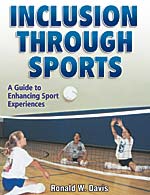
|
Legislation has forced physical educators to teach individuals with
disabilities. Physical educators do not always have the proper training,
equipment, or resources to teach this population. Modifications made
in teaching sports and sports skills can provide the physical educator
with
assistance in providing the individuals with disabilities success in
an
inclusion setting.
The purpose of this book provides information about legislation,
disability sports, disability sports organizations, sports skills,
modifications, and resources. Individuals who can benefit from the use
of this book are physical educators, adapted physical educators, regular
classroom teachers, pre-professional college students, recreational
therapists, Special Olympic coaches, and parents. The use of this book
would not be limited to the
groups mentioned. Anyone interested in individuals with disabilities
could
greatly benefit from this book.
Including references, the length of the book is two hundred sixteen
pages. The book is set up in five steps. Those steps include the following;
Step 1 - Locate a Sport
Step 2 - Cross Reference a Disability Sport
Step 3 - Learn About the Game and Its Skills
Step 4 - Match Your Student's Functional Level of Performance
Step 5 - Select and Implement an Appropriate Game
The steps are designed to help in adopting an entire disability sport
into a
curriculum or integrating specific sport skills from disability sports.
The
author reminds the reader that the choice is yours and to be open minded.
The content of the book is covered in four parts. Part 1 deals with
fundamentals. The fundamentals include legal background and wheelchair
basics. In Part 2, Invasion Games are introduced The following sports
listed in this part are wheelchair basketball, indoor wheelchair soccer.
The progression of each sport is a description of the sport, skills
to be taught, functional
profiles and general modifications, game progressions, games by skill
level
index: low functioning, game descriptions, games by skill level index:
moderate to high functioning, and game descriptions. Part 3 deals with
net games. Those games included are sitting volleyball
and wheelchair volleyball. The progression is the same. Court Games/Track
Events are the titles of Part 4. Listed in this part are goalball and
the slalom.
Again, the progression is the same. Appendix information contains legal
applications, wheelchair basics, links to other sports and adapted activities,
and
Equipment concerns.
Readers will find the setup of the book to be extremely user friendly.
The progression of each sport is valuable to physical educators whether
they are teaching adapted physical education or integrating into a regular physical
education curriculum. The appendix information provides resources which
are helpful and also suggested reading material will provide a wider
knowledge base.
Inclusion for Sports is a valuable resource as a supplement to a
Physical education curriculum. The information from this book would
allow any
individual enough material to provide success to individuals with disabilities.
I would rate this book a 5 for the content and application.
To Main
Book Review Page
|